
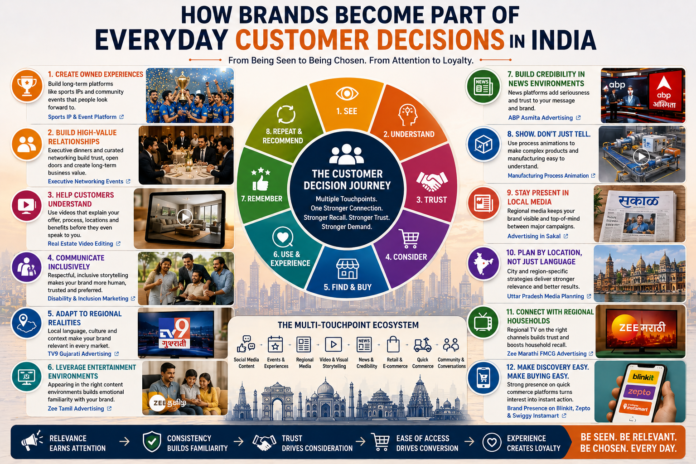


Most businesses think about marketing as a way to get noticed.
They launch a campaign, create a few advertisements, post regularly on social media, run an event, and wait for people to respond. Sometimes this creates an immediate spike in enquiries. Sometimes it increases reach. Sometimes it helps a new product get attention.
But being noticed is not the same as being remembered.
And being remembered is not the same as being chosen.
The brands that grow consistently are usually the brands that become part of a customer’s everyday mental shortlist. When someone needs the category, the brand already feels familiar. When someone sees the product in a store, on a marketplace, at an event, in a news environment or through a friend’s recommendation, it does not feel completely new.
It feels known.
This is one of the most valuable positions a brand can earn.
Customers do not always make decisions the first time they see a business. They may notice a name during a campaign, see it again in a regional media environment, watch a useful video a few weeks later, hear about the brand through a colleague, and only then take action when the need becomes real.
The marketing journey is rarely one straight line.
It is a collection of small signals that build familiarity over time.
The strongest companies understand this. They do not depend on one advertisement to create demand. They build a connected presence across communication, customer experience, content, events, media, retail, digital discovery and local relevance.
That is how a brand moves from being visible to becoming part of everyday customer decisions.
A Brand Needs More Than a Campaign. It Needs an Owned Idea.
Many companies build their marketing around promotions.
They advertise a discount. They run a launch offer. They create a seasonal campaign. They sponsor a post. They push one product feature. These activities can work, but they are often temporary.
Once the budget stops, the visibility disappears.
A stronger approach is to create something that the company can own over time.
This could be an event property, an industry conversation, a customer community, a sports initiative, an educational platform, a content series, a business forum, a research report, or a long-term brand experience.
The purpose is not only to create another event.
It is to create an idea that people associate with the company.
For example, a business that creates a recurring sports or community property can become connected with participation, local pride, team spirit, youth engagement and shared experiences. A business that creates a meaningful platform does not need to ask for attention every time. The audience begins to expect the experience.
A well-planned sports IP and event platform can help a company build something larger than a one-time activation. It can create repeat audience engagement, sponsor value, local participation, visibility and long-term recall.
The important part is consistency.
A customer may forget a single campaign. But they are far less likely to forget a brand that repeatedly creates useful, memorable and participatory experiences.
High-Value Relationships Are Built in Smaller Rooms
Not every important customer relationship begins through a mass campaign.
For many businesses, especially B2B companies, finance brands, technology businesses, real-estate developers, consulting firms, manufacturers and premium service providers, the most valuable conversations happen in smaller rooms.
A carefully chosen group of founders, decision-makers, investors, distributors, partners, customers or industry leaders can create stronger long-term value than thousands of generic impressions.
The key is not simply hosting a dinner or a networking evening.
The key is bringing the right people together for the right reason.
When a business creates a high-quality relationship environment, it can become known as a connector rather than merely another seller in the market.
A curated executive networking event can help build those relationships through thoughtful guest selection, private conversations, roundtables, founder dinners and high-trust discussions.
The event should not feel transactional.
Nobody wants to attend a room where every conversation becomes a sales pitch.
The strongest executive gatherings are built around shared interests, useful discussion, category insight and meaningful relationship-building. The commercial opportunity comes later, after trust has been established.
For companies trying to build long sales cycles, this kind of relationship marketing can become more valuable than chasing immediate leads.
Video Helps Customers Understand What They Are Considering
A customer may have heard about a brand, but that does not mean they understand it.
This is particularly true for real estate, technology, healthcare, manufacturing, education, infrastructure, financial services and other high-consideration categories.
People often need to see more before they enquire.
They want to understand what the product looks like, how the service works, what the location feels like, what the process involves, what kind of result they can expect and what makes the offer different from alternatives.
Video becomes useful because it gives the customer a way to experience the business before they speak to the sales team.
A property walkthrough, founder video, customer testimonial, factory tour, office visit, product demonstration or behind-the-scenes film can reduce hesitation before the first enquiry.
For brands working with property, infrastructure, premium spaces or local service discovery, real estate video editing can help turn raw footage into structured, sales-ready content that makes location, amenities, layout, use cases and customer value easier to understand.
The strongest videos are not simply cinematic.
They are clear.
They answer the questions customers are already asking.
What am I looking at? Why does this matter? How will this help me? What should I do next?
When a video gives customers confidence, it becomes more than content.
It becomes part of the decision-making process.
Inclusive Communication Creates a Stronger Brand Than Perfect Advertising
Brands often talk about trust as if it comes only from visibility, premium design or media exposure.
But trust can also come from how a business treats people.
Customers pay attention to whether a company’s communication feels respectful, accessible and human. They notice whether a brand speaks only to idealised consumers or whether it understands that real audiences have different needs, abilities, backgrounds and circumstances.
This is particularly important when communicating about healthcare, education, financial services, public programs, accessibility, community development, senior care, child welfare and social-impact initiatives.
The lesson is not that every commercial brand needs to become a charity.
The lesson is that communication should make people feel included rather than excluded.
An approach built around disability and inclusion marketing shows how dignity-led storytelling can create stronger engagement than messaging built around pity, fear or tokenism.
Commercial brands can apply the same principle.
A retail brand can make digital communication more accessible. A healthcare company can explain information more clearly. A financial company can reduce jargon. An education provider can design content for different learning needs. A consumer brand can avoid stereotypes and create communication that feels more representative of real customers.
These choices may look small.
But over time, they shape how people feel about the company.
And how people feel often determines whether they choose to engage.
Regional Relevance Cannot Be Added at the Last Minute
A brand may have one national message, one central campaign and one clear visual identity. That is useful.
But India is not one uniform market.
Customers in Gujarat, Maharashtra, Tamil Nadu, Delhi NCR, Uttar Pradesh, Telangana, Karnataka, West Bengal and other regions may respond differently to the same product story.
Language matters. Local media habits matter. Family structures matter. Buying patterns matter. Cultural moments matter. Even the type of proof a customer needs before trusting a product can change by market.
This is why strong expansion plans begin with relevance, not translation.
For brands entering Gujarat or building a stronger regional presence, a TV9 Gujarati advertising strategy can help shape a campaign around Gujarati-language audiences, local market conditions and region-specific visibility.
The strongest regional campaign does not simply replace English words with Gujarati, Hindi, Marathi, Tamil or Telugu copy.
It adapts the entire communication experience.
The product promise may remain the same. The visual identity may remain consistent. The core brand purpose may stay intact.
But the examples, tone, offer, customer story and media environment should feel familiar to the people being reached.
When a brand communicates in a way that feels natural to the market, customers are more likely to listen.
Entertainment Environments Can Create Emotional Familiarity
Not every customer chooses a brand through logic alone.
Many buying decisions are influenced by familiarity, comfort, aspiration, family discussion, nostalgia, entertainment and emotional association.
This is why entertainment-led media remains important.
A brand that appears in the right entertainment environment can become part of the customer’s leisure time rather than interrupting it.
For businesses targeting Tamil-speaking audiences, a Zee Tamil advertising plan can help create visibility around regional entertainment, family viewing, cultural connection and household-level familiarity.
The objective is not simply to place an advertisement in front of a large audience.
It is to understand what the audience is doing when they see the message.
Are they watching with family? Are they relaxing after work? Are they following a familiar programme? Are they in a mood to discover something new? Are they more likely to respond to emotional storytelling, product demonstration, humour, aspirational content or practical value?
The media environment affects the way a message is received.
A brand that understands that context can create stronger emotional recall than one that simply chases reach.
News Environments Help Customers Take Certain Brands More Seriously
Some products are bought quickly.
Others require credibility.
A customer may buy a snack after seeing an attractive image. But they may need more confidence before choosing an insurance product, investment platform, healthcare provider, real-estate project, educational institution, financial service or large-ticket consumer product.
In these categories, the environment around the message matters.
A brand that appears in a familiar news context can feel more established, more visible and more trustworthy than one that only appears through standard promotional advertising.
For businesses looking to build stronger visibility among Gujarati audiences, ABP Asmita advertising can help create regional news-based communication around awareness, launches, expert content, sponsorships and market-specific trust-building.
The campaign still needs a clear message.
A news placement cannot make a weak offer stronger by itself.
But when a business has something meaningful to say, such as a new expansion, public-awareness initiative, customer benefit, expert perspective, research insight, product launch or community program, the right media environment can help that message carry more weight.
Trust often grows when the audience sees the brand in places they already recognise.
Customers Believe What They Can See
For many businesses, one of the biggest barriers to purchase is uncertainty.
Customers may not understand how a product is made. They may not know what happens behind the scenes. They may not be able to visualise the scale of production, the quality process, the technology, the materials, the supply chain or the final result.
This is where visual explanation becomes powerful.
A company does not always need to explain everything through paragraphs, brochures or sales presentations. It can show the process.
For businesses selling products online, manufacturing equipment, industrial solutions, consumer goods or technical services, manufacturing process animation for e-commerce can help show how raw materials become finished products and how systems work behind the scenes.
This type of content is useful because it makes the invisible visible.
A customer can understand product quality more clearly. A distributor can see production capability. An investor can understand operational scale. A B2B buyer can evaluate the process. A consumer can feel more confident about what they are purchasing.
The goal is not to create visual effects for the sake of it.
The goal is to remove doubt.
When a brand helps people understand more, it often becomes easier to trust.
Local Media Can Keep a Brand Present Between Major Campaigns
A national campaign may create awareness, but local media helps maintain presence.
This is important because customers often make decisions over time. They may see a brand during a major launch, but they may not act until weeks or months later. If the company disappears after the campaign ends, the earlier attention may fade.
Regional newspapers, city publications, local news platforms and community media can help maintain relevance.
For businesses building familiarity across Maharashtra, advertising in Sakal can support local visibility through a Marathi news environment that reaches people who follow regional, civic and community developments.
The value of local media is not only scale.
It is context.
A brand can be part of the conversations that matter in a city. It can support local launches, retail expansion, property awareness, healthcare education, community initiatives, event promotion, seasonal offers, dealer outreach and service visibility.
When customers see a company repeatedly in familiar local environments, the brand becomes easier to recognise when the need appears.
Location Planning Is More Important Than Broad Hindi Reach
Hindi-speaking audiences are large, but they are not one single market.
A campaign designed for Delhi NCR may not work in Lucknow. A message that feels right for Jaipur may need adjustment for Kanpur. A product that performs in Gurugram may need a different offer, distribution plan or communication style in smaller cities across Uttar Pradesh.
This is why businesses should not think only about language.
They should think about geography.
Where are the customers? What cities matter most? Which markets are ready for the product? What media reaches those customers? Which channels fit the audience? What kind of messaging makes sense in that location?
A focused Uttar Pradesh media planning strategy can help businesses understand how Hindi communication should be shaped around a real market rather than a broad national assumption.
The strongest Hindi campaigns are not generic.
They are specific.
They understand whether the objective is awareness, local trust, retail discovery, admissions, footfall, healthcare education, product trial, service enquiries or marketplace conversion.
The more clearly a brand defines the geography, the more useful the media plan becomes.
Maharashtra Consumer Growth Requires More Than a Marathi Translation
Maharashtra is one of India’s most important consumer markets.
But businesses often underestimate the difference between simply running Marathi creative and building a genuinely Maharashtra-focused campaign.
A consumer brand needs to consider how people shop, where they discover products, what type of content they watch, what family conversations influence buying decisions, which stores or quick-commerce platforms customers use and what kind of visibility creates trust.
For FMCG and retail brands, a Zee Marathi FMCG advertising approach can help connect household-level reach with product discovery, seasonal campaigns, retail awareness and repeated communication.
The strongest campaigns often combine television, social content, local retail presence, quick-commerce availability, regional language communication and visible product proof.
The customer should not feel that the brand is only advertising in Maharashtra.
The customer should feel that the brand understands Maharashtra.
That distinction can shape how quickly a product moves from awareness to trial.
The Final Decision Often Happens on a Small Mobile Screen
A company may invest heavily in media, events, regional communication, video content, brand visibility and local marketing.
But the final purchase decision may still happen on a smartphone.
A customer may see the product in an advertisement, search for it later, open a quick-commerce app, compare the thumbnail, check the packaging, review the price, understand the pack size and decide within seconds whether to add it to the cart.
This is why quick-commerce visibility cannot be treated as a separate activity.
It is part of the brand experience.
A useful guide to building brand presence across Blinkit, Zepto and Swiggy Instamart explains why consistency and platform-specific adaptation need to work together.
The product should look recognisable across every platform.
The packaging should be easy to understand in a small thumbnail.
The product name should be clear.
The promise should make sense immediately.
The listing should help the customer decide, not create more questions.
A brand campaign may create attention.
But the product page is where attention becomes action.
The Brands That Last Do Not Depend on One Moment
A brand becomes part of everyday customer decision-making through repetition, relevance and proof.
It creates something people can remember. It builds relationships that matter. It makes its product easier to understand. It communicates with respect. It adapts to regional markets. It appears in relevant media environments. It remains visible in local conversations. It helps customers find and buy the product easily.
None of these activities work perfectly in isolation.
But together, they create a stronger system.
The customer may first hear about the brand through a local campaign. They may later see it in a familiar entertainment environment. They may notice it in regional news. They may watch a video that explains the offer. They may see proof of quality. They may find the product on a quick-commerce platform. They may finally decide to buy.
That is how attention becomes familiarity.
That is how familiarity becomes trust.
And that is how trust becomes repeat demand.